Independent food safety manager exam prep editors
Direct answer
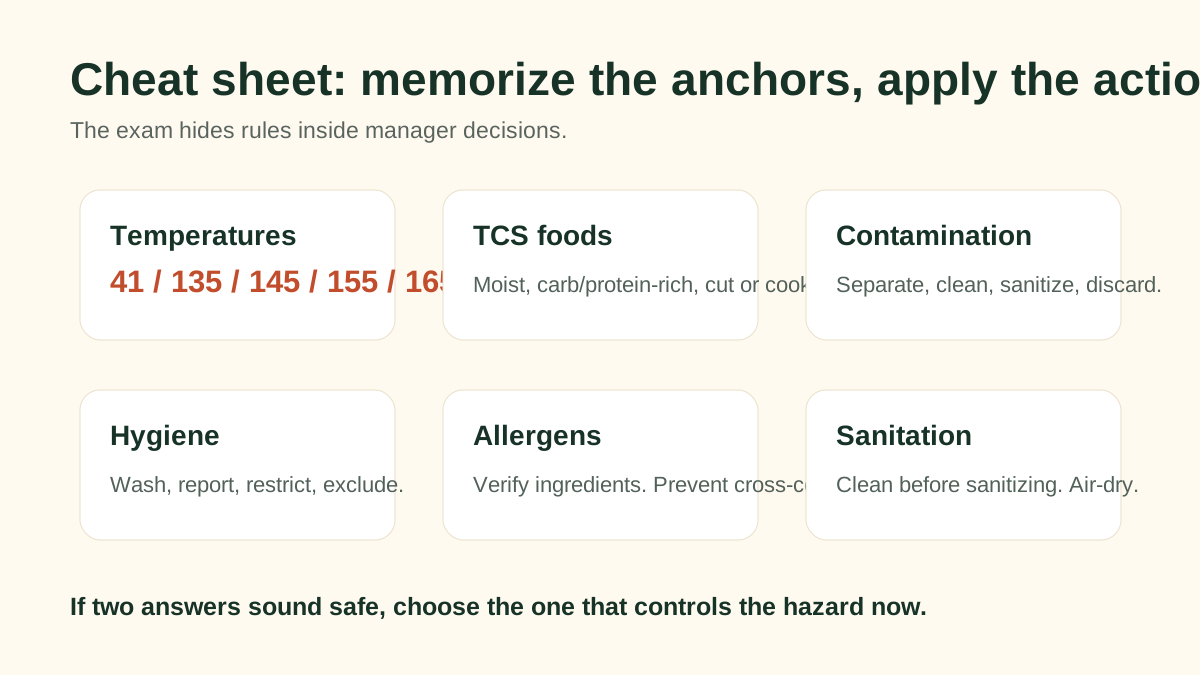
A useful ServSafe Manager cheat sheet is not just a list of facts. It should help you choose the safe manager action when the question mentions a delivery, a sick employee, a cooling log, a storage problem, an allergen request, or a dirty food-contact surface.
These are common FDA model Food Code cases, not an official exam handout. Use your provider's exam materials and locally adopted requirements; USDA home-cooking guidance is a separate setting.
Temperature anchors
Memorize these numbers, but always connect them to the task in the question.
- 41°F or lower: cold holding for TCS food.
- 135°F or higher: hot holding for TCS food.
- 145°F for 15 seconds: seafood, steaks, chops, and eggs for immediate service.
- 155°F for 17 seconds: ground meat and injected meat.
- 165°F instantaneously: conventionally cooked poultry and specified stuffed foods under FDA Food Code 2022 and 2026.
- 165°F for 15 seconds: TCS food cooked and cooled in the operation, then reheated for hot holding; reach the target within 2 hours.
Cooling, reheating, and holding
Cooling and reheating questions are where many learners lose points because the scenario includes both time and temperature.
- Cooling stage 1: 135°F to 70°F within 2 hours.
- Cooling stage 2: 70°F to 41°F or lower within the next 4 hours.
- If food misses the 70°F checkpoint, choose corrective action rather than simply continuing to cool.
- For hot holding, food cooked and cooled in the operation generally needs reheating to 165°F for 15 seconds within 2 hours. Commercially processed, packaged ready-to-eat food generally needs 135°F; microwave reheating and qualifying roasts have separate provisions.
- Hot holding after food is safe: 135°F or higher.
- Cold holding after food is safe: 41°F or lower.
TCS foods and storage order
If the food is TCS, the manager usually needs a time, temperature, date-marking, cooling, reheating, or discard decision.
- Common TCS foods: meat, poultry, seafood, eggs, dairy, cooked rice, cooked beans, cooked potatoes, cut melons, cut tomatoes, cut leafy greens, tofu, sprouts, and untreated garlic-oil mixtures.
- Store ready-to-eat foods above raw foods.
- Store raw foods by final cooking temperature so higher-risk raw items cannot drip onto lower-risk foods.
- Keep chemicals away from food, equipment, utensils, linens, and single-use items.
Hygiene, allergens, cleaning, and sanitizing
These topics often appear as manager judgment questions, not vocabulary questions.
- Do not let a sick employee continue food handling when symptoms require restriction or exclusion.
- For allergen requests, do not guess ingredients; verify, communicate, and prevent cross-contact.
- Cleaning removes food and soil. Sanitizing reduces pathogens on a clean surface.
- For food-contact surfaces, think wash, rinse, sanitize, air-dry.
- Clean and sanitize when switching from raw animal food to ready-to-eat food.
Five self-check scenarios
Answer these without looking back. These are on-page study prompts, not a scored practice session.
- A soup is 80°F after 2 hours of cooling. What checkpoint failed?
- A foodservice ground-beef burger reaches 145°F for 15 seconds. Does it meet the chart's ground-meat option?
- A customer reports a severe sesame allergy. What should staff avoid doing?
- A cutting board still has food debris after being sprayed with sanitizer. What step was missed?
- Raw chicken is stored above ready-to-eat salad. What is the manager-level correction?
Check your answers, then practice what you missed
An incorrect answer tells you which topic to work on next; it does not measure exam readiness.
- Soup: the first cooling checkpoint failed—70°F within 2 hours. Do not rely only on the final 41°F target. Practice cooling checkpoints
- Burger: no. That fish/whole-cut combination is not the ground-meat option of 155°F for 17 seconds; equivalent listed combinations also apply. Practice cooking categories
- Sesame allergy: do not guess ingredients or promise safety. Verify the recipe, communicate with the guest and kitchen, and prevent allergen cross-contact. Practice allergy communication
- Board: cleaning was missed. Remove food and soil, rinse, sanitize, and air-dry; sanitizer does not replace washing. Practice cleaning versus sanitizing
- Chicken: separate it below ready-to-eat salad; protect the salad from raw-food drips. Practice cooler storage order