Reviewed 2026-10-07; official references are listed below.
Direct answer
Cleaning removes food and soil. Sanitizing reduces microorganisms on a cleaned surface to a safe level; it does not remove leftover grease or crumbs or make the surface sterile. A surface that touches food needs both before reuse after cleaning (FDA §1-201.10 and §§4-601.11 and 4-702.11).
This is independent exam preparation, not official ServSafe material. Sources were checked on October 7, 2026; that is a source check, not a credentialed expert review. FDA’s 2026 Food Code is a model for jurisdictions, not proof that your local authority or exam provider uses that edition. Follow your adopted rules and current course materials.
The order to remember
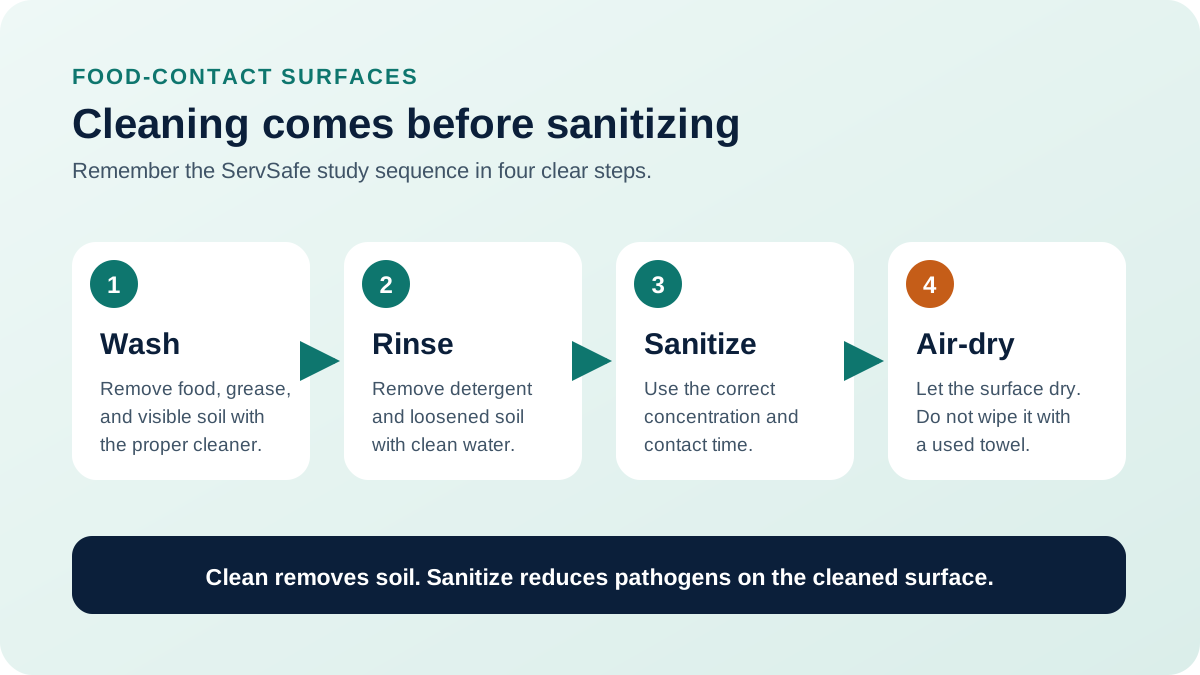
For ordinary manual washing, remember wash → rinse → sanitize → air-dry. Scrape off debris first. Specialized detergent-sanitizer systems have separate provisions; do not treat them as permission to skip a normal rinse (FDA §§4-603.12/.14/.16 and 4-501.115).
- Wash: remove food, grease, and visible soil.
- Rinse: remove the cleaning solution and loosened soil with water.
- Sanitize: use a food-contact sanitizer as labeled, with the required concentration and contact time.
- Air-dry: do not towel-dry newly sanitized equipment. The model code also permits use after adequate draining; clean, dry cloth polishing is reserved for utensils already air-dried (§4-901.11).
The four-hour rule: scope and exceptions
The default is cleaning at least every four hours for equipment and utensils used with time/temperature control for safety (TCS) food. Sanitize before reuse after cleaning. This is not a universal four-hour timer for every wall, floor or piece of equipment (FDA §§4-602.11(C) and 4-702.11).
- Clean and sanitize sooner when switching from raw food to ready-to-eat food, or whenever contamination may have occurred (§4-602.11(A)).
- Specified exceptions exist: for example, storage containers holding TCS food at required temperatures may be cleaned when empty (§4-602.11(D)(1)). That does not exempt an ordinary prep board.
- Refrigerated preparation areas can qualify for longer intervals only under the specified temperature/frequency table and documented schedule (§4-602.11(D)(2)); a cool-feeling kitchen is not enough.
Concentration and contact time: read the actual label
There is no one ppm value or contact time for every sanitizer. FDA §§4-501.114/.116 and 4-703.11 address the product, concentration, temperature, pH or water hardness, testing and exposure time. Use the appropriate test kit; smell or color is not a measurement.
EPA explicitly says a shorter Food Code minimum does not override a longer registered-label contact time. Do not add extra chemical to ‘make it stronger’ or shorten the labeled exposure time.
Sanitizing is not the same as disinfecting
EPA treats sanitizing and disinfecting as different product claims; some products have both. A disinfectant for a bathroom is not automatically suitable for a food-contact surface. Check the permitted surface, use directions and any required rinse. Routine sanitation is not a substitute for the establishment’s vomit or diarrhea cleanup procedure.
Four self-check scenarios
Choose the next action before reading the answers. These are our original learning examples, not official examination questions.
- 1. A board used for raw chicken an hour ago is needed for lettuce. Wait for the four-hour deadline, or clean and sanitize now?
- 2. A worker sprays sanitizer onto a table with visible crumbs. Has the full process been completed?
- 3. A food-contact sanitizer’s label requires one minute of contact. Can the worker stop after ten seconds because a general chart lists that number?
- 4. A just-sanitized utensil is still wet. Should the worker dry it immediately with a clean towel?
Check your answers, then practice
- Clean and sanitize now. Raw-to-ready-to-eat is a task-change trigger; the four-hour interval is not permission to delay (§4-602.11(A)(2)).
- No. Remove the crumbs, wash and rinse, then sanitize and air-dry. Spraying does not replace cleaning (§§4-601.11, 4-603.14/.16, 4-702.11).
- No. Complete the label’s one-minute contact time. EPA’s label guidance specifically rejects substituting a shorter general minimum.
- No. Air-dry or use after adequate draining under the applicable procedure; newly sanitized utensils must not be cloth-dried (§4-901.11).