Reviewed 2026-10-07; official references are listed below.
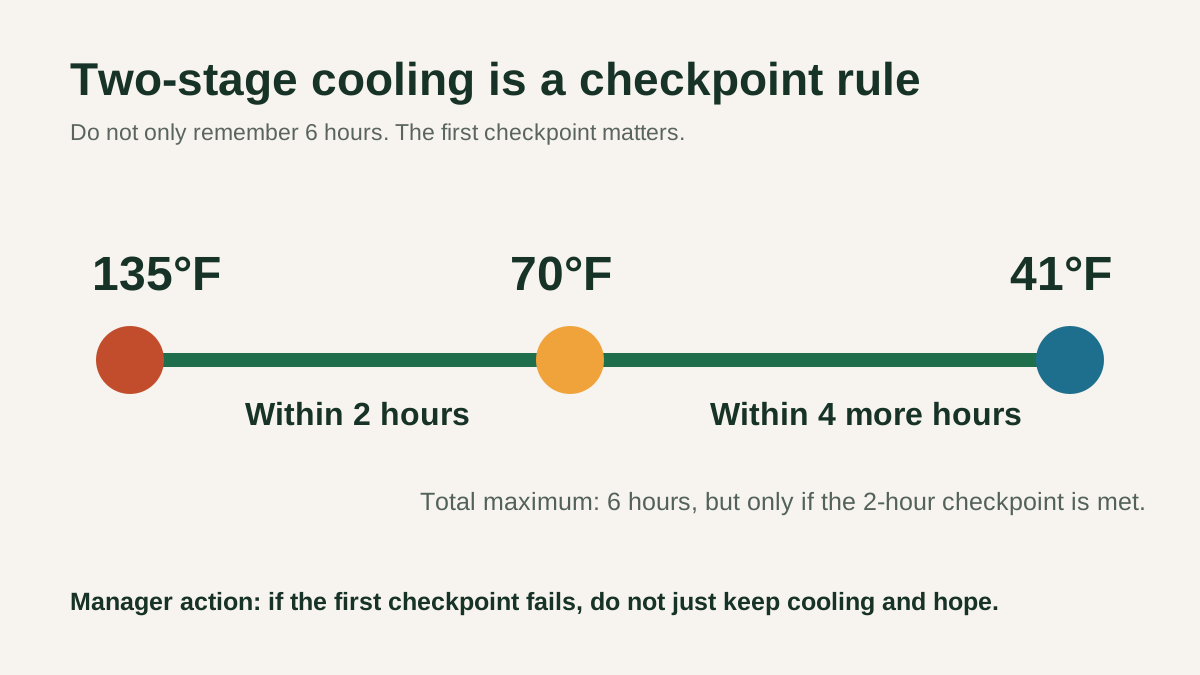
Direct answer
For cooked time/temperature control for safety (TCS) food, FDA Food Code §3-501.14(A) sets two limits: cool from 135°F (57°C) to 70°F (21°C) within 2 hours, and from 135°F to 41°F (5°C) or lower within 6 hours total. Passing the final limit does not erase a missed first checkpoint.
The familiar ‘2 hours plus 4 hours’ assumes the first stage takes all 2 hours. If 70°F is reached after 1 hour, up to 5 hours remain to reach 41°F within the original 6-hour total. Start the clock at 135°F; do not restart it at 70°F. FDA Annex 7, item 20, explains this total-time calculation.
The Food Code is a model, not automatically the law in every state. Check your regulator’s adopted rules and your exam provider’s current materials. Sources were checked on October 7, 2026; this is not a claim of professional review.
How to solve cooling questions
Cooling questions usually give a time and a temperature. Do not jump straight to the final 41°F target. First ask whether the food hit 70°F within 2 hours.
- Step 1: Is the food cooked TCS food that is cooling?
- Step 2: Did it move from 135°F to 70°F within 2 hours?
- Step 3: Did it reach 41°F or lower within 6 hours of the original 135°F reading?
- Step 4: Check elapsed time and documented history before choosing a corrective action; reheating is not a universal rescue.
Safe cooling methods
FDA §3-501.15(A) lists methods suited to the food being cooled. A cooler alone does not prove that a deep pot will meet the deadlines: measure food temperature, not just cooler air.
- Divide food into shallow pans.
- Separate large batches into smaller portions.
- Use ice-water baths or ice paddles.
- Stir food to distribute heat.
- Arrange containers for heat transfer; loosely cover them, or leave them uncovered only when protected from overhead contamination (§3-501.15(B)).
- Use blast chillers when available.
Different food preparation, different limit
Do not apply the cooked-food six-hour clock to every refrigerated preparation. Under §3-501.14(B), TCS food made with room-temperature ingredients, such as reconstituted food or canned tuna, must reach 41°F or lower within 4 hours. This is a separate preparation rule, not an extra allowance added to cooked-food cooling.
Corrective action: act early, do not reset an unsafe history
FDA Annex 5 provides inspection guidance, not a blanket permission in §3-501.14 to restart any failed batch. For cooked hot food still above 70°F at 2 hours or less, its guidance allows reheating to 165°F for 15 seconds and starting again with a different cooling method. Follow the applicable local procedure and document the time and temperature.
Its discard guidance applies when cooked food is still above 70°F after more than 2 hours, or above 41°F after more than 6 hours. Do not simply continue cooling, reset the clock, or use a later 41°F reading to excuse the earlier failure. If the history cannot be established, do not assume reheating makes it safe; withhold it from service and follow the person in charge’s regulator-compliant disposition procedure.
- Record the 135°F starting time and food temperatures before each deadline, leaving time to intervene.
- Check representative warm areas with a suitable, clean thermometer; a single cold edge is not evidence that the whole batch cooled.
- Change an ineffective method early: smaller portions, shallow containers, stirring in an ice bath, or suitable rapid-cooling equipment.
Four self-check scenarios
- 1. Soup reaches 70°F in 1 hour and 41°F at 5 hours 30 minutes total. Did it meet both limits?
- 2. Chili is 78°F at 2 hours 15 minutes, then reaches 41°F at 5 hours. Does the final reading rescue it?
- 3. A monitored batch is 82°F at 1 hour 45 minutes. Does the FDA early-correction guidance require simply leaving it in the same deep pot?
- 4. Tuna salad is prepared with room-temperature ingredients and reaches 41°F after 5 hours. Can you use the cooked-food six-hour rule?
Check your answers, then practice cooling
- Yes, on the stated measurements: the first stage took less than 2 hours and the total was less than 6. The second stage does not have a fixed four-hour maximum when the first stage finishes early.
- No. It missed the 70°F checkpoint beyond 2 hours; FDA Annex 5 directs discarding. A later cold reading does not undo that history.
- No. It is still within the early correction window. Annex 5 allows reheating to 165°F for 15 seconds and restarting with a different cooling method under the applicable procedure—not waiting indefinitely in the same setup.
- No. This preparation has a four-hour limit to reach 41°F under §3-501.14(B), not the cooked-food six-hour limit. Ready to test those distinctions? Start the two-stage cooling practice.