Reviewed 2026-07-31; official references are listed below.
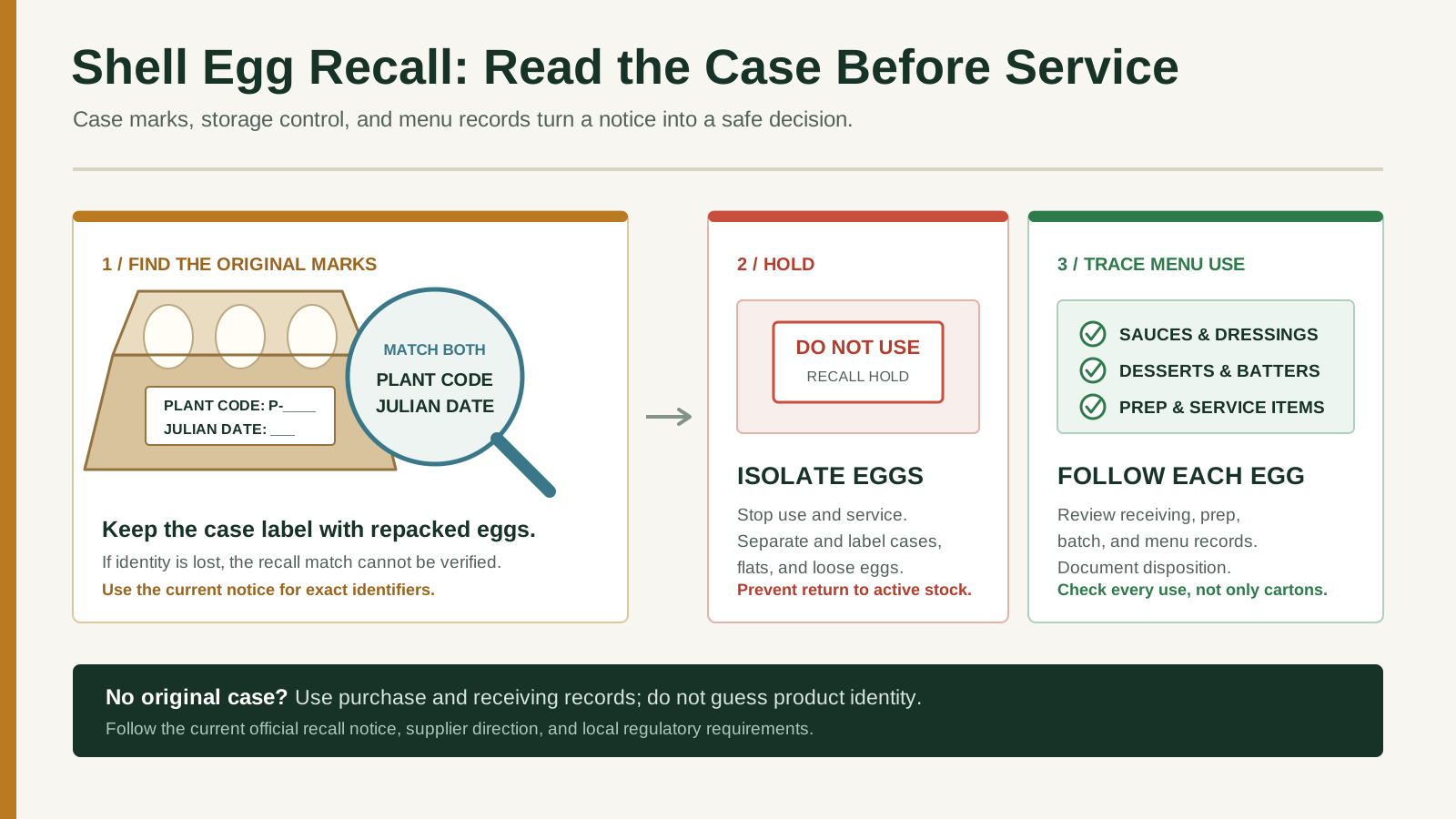
Direct answer: what should a restaurant do now?
Stop using any shell eggs that may match the Midwest Poultry Services recall. The recalled products are specific white shell eggs and brown cage-free shell eggs carrying identifying code P-1950 or 0840962 and a Julian date from 157 through 184, with sell-by or best-by dates from July 20 through August 17, 2026. Do not sell, serve or "cook through" a recalled egg. Quarantine matching or untraceable stock, verify it against the original carton and purchasing records, then return or discard confirmed recalled product according to supplier instructions. Clean and sanitize every item and surface that may have contacted it.
Who this checklist is for
This on-shift guide helps restaurant managers, chefs, receiving staff, commissaries and retail food operators answer three questions: Do we have the recalled product? Where could it have gone? What must we control before service continues?
This page does not declare every egg unsafe or replace supplier, health department or adopted-code instructions. The FDA Food Code is a model, not one nationwide restaurant law.
Incident snapshot as of July 31, 2026
FDA and CDC were investigating a multistate outbreak of Salmonella Enteritidis linked in part to eggs recalled by Midwest Poultry Services, L.P. FDA's latest posted case update was July 24, 2026: 98 illnesses in 17 states, 26 hospitalizations and no reported deaths. Illness onsets ranged from November 21, 2025, through June 30, 2026.
Midwest Poultry Services initiated the voluntary recall on July 22, 2026 after sharing third-party testing results with FDA. FDA states that recalled eggs are a likely source of illnesses, but also states that this producer does not account for every illness in the outbreak. The investigation remained ongoing.
Keep case states separate from distribution states. Cases were reported in Arizona, California, Colorado, Georgia, Illinois, Louisiana, Michigan, Missouri, Mississippi, North Carolina, New Mexico, Nevada, New York, Oklahoma, South Carolina, Texas and West Virginia. Confirmed distribution was Arkansas, Louisiana, Mississippi, New Mexico, Oklahoma and Texas, but FDA said product could have traveled farther. Check identifiers and purchasing records even outside those states.
Exactly which eggs are in the recall?
Use all available identifiers. Brand or egg color alone is not enough. The table below is an intentionally incomplete operational summary, not a substitute for FDA's full product/UPC table and carton photographs.
| FDA table group | Listed specifications | Code shown in FDA item table |
|---|---|---|
| Kroger: alternate-code rows | Large 12 (011110609038); Large 18 (011110609335); Extra Large 12 (011110609045); Medium 12 (011110609021); Jumbo 12 (011110609052) | P-1950 or 840962 |
| Kroger: P-code-only rows | Large 60 (011110609144); Medium 30 (011110609809) | P-1950 only |
| Other listed retail brands | Simple Truth cage-free brown; Brookshire's; Country Morning; Cal-Maine Sunups/Sunups | FDA item rows show P-1950; use the full table for exact specification and UPC |
| Foodservice bulk | Grade AA Large 30-dozen; Grade A Large 15-dozen; Large TICTAC; Large BROWN-TICTAC; Medium 30-dozen; Medium 15-dozen; Extra Large 15-dozen; Jumbo 20-egg | P-1950; UPC listed as N/A |
All rows use Julian dates 157-184 and sell-by or best-by dates from July 20 through August 17, 2026. These white or brown cage-free shell eggs came from Texas farms between June 6 and July 3, 2026. No other Midwest Poultry Services products were included.
Important code-format note
FDA and CDC narrative identifies 0840962; the FDA table displays 840962 only as an alternate for the five Kroger specifications above, not every recalled product. Do not generalize it. Hold an ambiguous carton and compare specification, UPC, date, carton photograph, invoice and supplier confirmation.
The first 15 minutes: stop, hold, trace
- Stop use at prep, bakery, bar and catering stations.
- Preserve identifiers: carton, case label, invoice, receiving log and a code-panel photograph.
- Quarantine suspect product away from usable food; mark it DO NOT USE - RECALL HOLD with time and initials.
- Hold affected preparations, including pooled eggs, batters, sauces and desserts. Do not blend batches.
- Notify the supplier. FDA advises operators that handled recalled or potentially contaminated food to contact their local health department.
This sequence is an operational control recommendation based on FDA and CDC recall instructions. Your regulator or supplier may require additional steps.
Receiving-room carton code inspection guide
Use this check for stock already in the cooler and for every incoming delivery while the recall is active.
| Receiving check | Pass | Hold or reject |
|---|---|---|
| Original carton or case label | Source and codes are legible and traceable | Label missing, divided carton has no retained source, or codes cannot be tied to an invoice |
| Recall code | Product does not match the FDA table | P-1950 on a listed product, or 840962 on one of the five listed Kroger specifications; hold a narrative 0840962 match for verification |
| Julian date | Outside 157-184 | Within 157-184, or unreadable while source may match |
| Sell-by / best-by date | Outside July 20-August 17, 2026 | Inside the window, or missing while other identifiers may match |
| Temperature | Received in refrigerated equipment at an ambient air temperature of 45°F (7°C) or below | Above 45°F (7°C), or evidence of temperature abuse; follow the adopted local code and receiving policy |
| Shell/package condition | Eggs are clean and sound; packaging protects the product | Cracked, leaking, dirty or damaged product |
The 45°F (7°C) receiving criterion, clean-and-sound condition and immediate refrigerated storage are FDA Food Code model provisions. Local requirements may differ, so apply the code adopted by the authority having jurisdiction.
Decision tool for divided or unlabeled cartons
- Code and invoice trace to a nonrecalled source: document and release under normal controls.
- Original code confirms the recall: keep quarantined; return or discard as directed. Never relabel it as usable.
- An unlabeled carton can be traced: hold until the manager documents supplier, original code and date.
- Source cannot be reconstructed: do not serve; ask the supplier and local regulator for disposition.
Appearance, smell or a float test cannot establish that an egg is outside this recall. USDA explains that floating reflects an enlarged air cell and poor quality but does not by itself decide safety; recall release still depends on traceable identifiers.
Sweep the menu, not just the walk-in
Start where shell eggs were stored or broken, then trace recipes and production logs.
| Area | What to look for | Immediate control |
|---|---|---|
| Breakfast line | Fried eggs, poached eggs, omelets, scrambled-egg mix | Stop use; identify the source carton and any pooled batch |
| Cold prep | House Caesar dressing, aioli, mayonnaise, hollandaise-style sauces | Hold if made with suspect shell eggs; verify whether a documented pasteurized product was used |
| Bakery or dessert | Tiramisu, mousse, meringue, custard, batter, egg wash | Trace batch date and egg lot; hold affected finished and in-process food |
| Bar or beverage | Egg-white cocktails, eggnog or egg-fortified drinks | Stop service until the egg source and pasteurization status are verified |
| Catering or commissary | Transferred pans, satellite coolers and off-site mise en place | Notify receiving locations; identify every transfer from the suspect lot |
FDA's retail egg guidance calls for pasteurized eggs or egg products in recipes such as Caesar dressing, mayonnaise, hollandaise, meringue, eggnog, ice cream and egg-fortified beverages when they will not be thoroughly cooked. The 2022 Food Code also calls for pasteurized substitution for specified raw or undercooked preparations, subject to the code and exceptions adopted locally.
Quarantine, return or discard log
Use one row per product or prepared-food batch. Exclude customer names and medical information.
| Field | Record |
|---|---|
| Date/time placed on hold | |
| Product, brand and pack size | |
| Plant code / identifying code | |
| Julian date and sell-by/best-by date | |
| Supplier and invoice/PO reference | |
| Quantity received / quantity remaining | |
| Menu items or batches potentially affected | |
| Storage and food-contact areas checked | |
| Supplier instruction and contact time | |
| Regulator/corporate notification, if applicable | |
| Final disposition: returned or discarded | |
| Date/time, quantity and manager verification |
Cleaning and restart control
CDC tells businesses to wash and sanitize items and surfaces that may have contacted recalled eggs. Keep food-contact sanitizing separate from general surface disinfecting.
Food-contact equipment and utensils: contain the eggs, discard material that cannot be cleaned, remove food and soil, wash, rinse, then apply a product labeled for food-contact sanitizing at its labeled dilution and contact time. Follow label directions for draining, air-drying or a potable-water rinse.
General hard surfaces: first remove visible soil. If the establishment uses a disinfectant on cooler handles, floors or other non-food-contact surfaces, confirm that the label covers that site and surface, then follow its directions and wet contact time. Do not apply a general surface disinfectant to food or assume that a disinfectant is automatically approved for food-contact use.
Wash hands after cleanup and separate held product, waste and clean equipment before reopening. Do not improvise a chemical concentration; the product label and adopted local procedure control.
Recall response is not an ordinary cooking decision
For eggs that are not recalled, the FDA model uses 145°F (63°C) for 15 seconds for shell eggs broken for one customer's order and immediate service. For other raw-egg preparations, FDA's retail guide highlights the common 155°F (68°C) for 17 seconds combination. The Food Code model also provides equivalent combinations of 145°F (63°C) for 3 minutes, 150°F (66°C) for 1 minute, or 158°F (70°C) for less than 1 second. Microwave-cooked egg food reaches 165°F (74°C) throughout and stands covered for 2 minutes.
Those cooking controls do not rescue recalled product. The outbreak instruction is simpler: do not sell or serve recalled eggs; return or discard them.
For raw, lightly cooked or pooled recipes, use an appropriate documented pasteurized shell egg or egg product. Pasteurization does not make an already recalled egg acceptable.
Do not make these mistakes
- Do not discard a carton before recording codes and supplier.
- Do not decide by brand alone; use the recalled code/date combination.
- Do not confuse the 17 case states with the six confirmed distribution states.
- Do not combine held eggs with new stock.
- Do not use recalled eggs in a fully cooked item.
- Do not release prepared food until its source lot is resolved.
- Do not claim that Midwest Poultry Services explains every outbreak illness; FDA says it does not.
- Do not describe the FDA Food Code as the law in every jurisdiction.
Related Food Safety Prep resources
- Review ordinary storage decisions in How Long Can Eggs Sit Out?.
- Recheck delivery controls in Receiving Temperatures.
- Separate the two steps correctly with Cleaning vs. Sanitizing.
- Prevent transfer from raw egg areas with Cross-Contamination.
- Use the broader recall workflow in 2026 Iceberg Lettuce Recall: Restaurant Checklist.
- Refresh core manager decisions in Food Safety Answers.
Educational disclaimer
This checklist is not a recall notice, legal or medical advice, or regulatory instruction. Verify current FDA and CDC details and apply local requirements.