Reviewed 2026-07-31; official references are listed below.
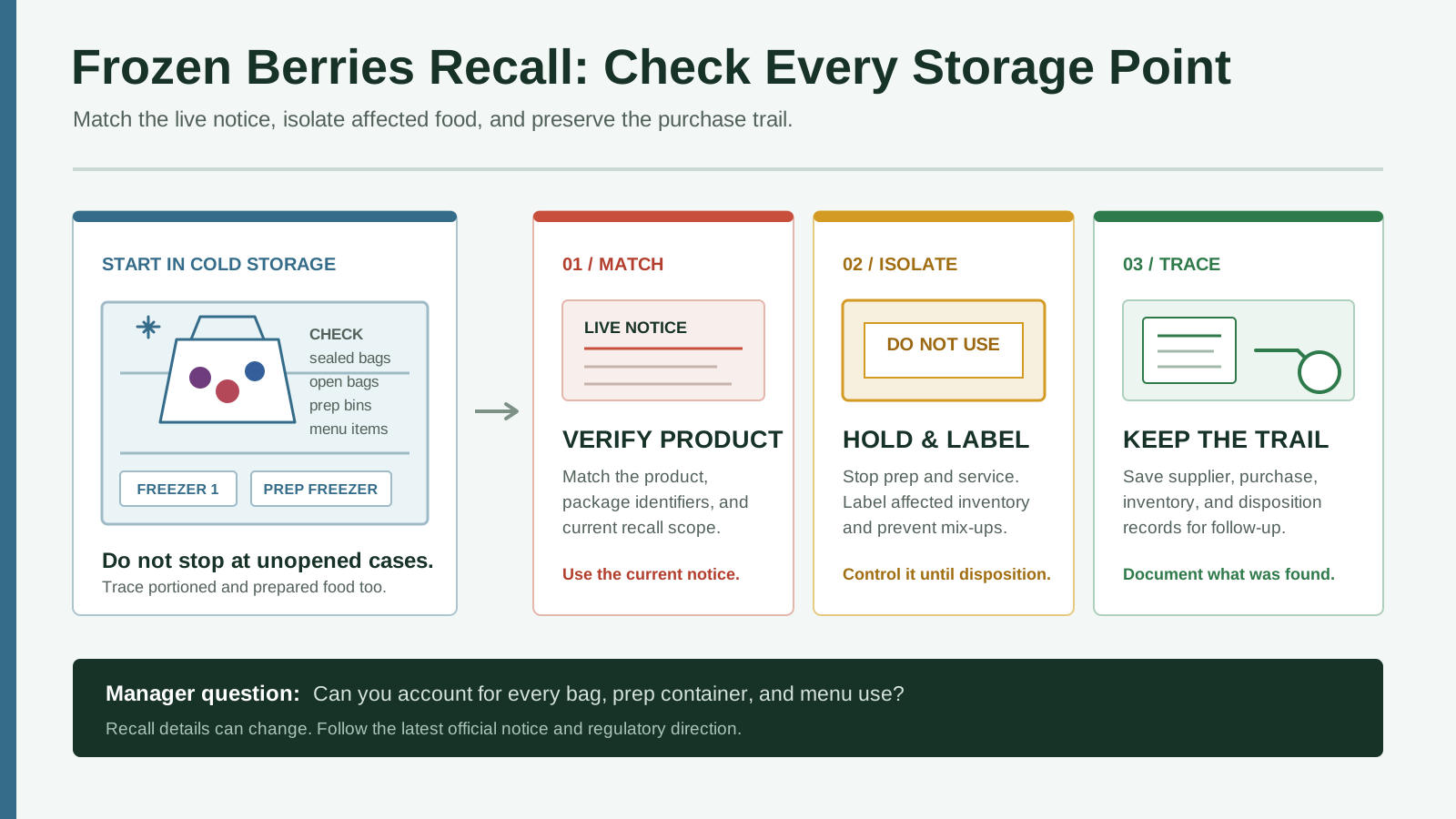
Direct answer - incident snapshot (source check: July 31, 2026)
Do not sell, serve or use any lot of the four recalled GreenWise Organic frozen berry products listed below. Publix announced the expanded recall on July 29, 2026, and FDA and CDC posted updates on July 30. The investigation remains ongoing. FDA reports 12 illnesses in Florida and Georgia, including four hospitalizations and no deaths; that case geography is separate from the eight confirmed retail-distribution states, and FDA says product may have reached other states.
For restaurant, retail and commissary teams that bought the berries from Publix or by internal transfer. This does not replace official notices, supplier instructions, local direction or medical care.
Scope: all lots of the four GreenWise Organic product/UPC combinations below. This is not a recall of every frozen berry, GreenWise product or Publix brand.
Which products are recalled?
| Product | Package | UPC | Current scope |
|---|---|---|---|
| GreenWise Organic Whole Blueberries | 10 oz | 41415-06453 | All lots |
| GreenWise Organic Whole Blueberries | 48 oz | 41415-12053 | All lots |
| GreenWise Organic Whole Mixed Berries | 10 oz | 41415-06753 | All lots |
| GreenWise Organic Whole Mixed Berries | 48 oz | 41415-12153 | All lots |
The eight confirmed retail-distribution states are Alabama, Florida, Georgia, Kentucky, North Carolina, South Carolina, Tennessee and Virginia. FDA cautions that product could have been distributed further and reached other states. The recalled products must not be used, sold or served.
On July 3, the supplier recalled one 10 oz blueberry lot: 60401 (printed 6 040 01), best by February 9, 2028. Preserve that as recall history, but use the later July 29 scope: all lots of all four products. A different lot or date does not clear a listed product.
Case states are not distribution states
The FDA outbreak page reported 12 illnesses in two case-reporting states, Florida and Georgia. Four people were hospitalized and no deaths had been reported. Illness onset dates ranged from May 11 through June 5, 2026. Seven of nine interviewed people reported eating frozen blueberries, and five specifically reported GreenWise organic frozen blueberries purchased from Publix.
The recalled products, however, have eight confirmed retail-distribution states, and FDA says they may have reached other states. Use product identity, UPC, supplier and purchase records, not a case map. An operation outside Florida or Georgia is not automatically outside the recall.
The first 15 minutes
This timing is an editorial shift target, not a government deadline. Stop service first, then trace and document.
| Target time | Manager action | What “done” looks like |
|---|---|---|
| Minute 0-2 | Stop use and sale | Alert prep, bar, bakery and service leads. Disable affected menu items. |
| Minute 2-5 | Secure stock | Mark opened and sealed packages DO NOT USE - RECALL HOLD and segregate them. |
| Minute 5-8 | Search every location | Check all freezers, catering storage, secondary containers and preportioned cups. |
| Minute 8-11 | Trace prepared food | Place foods made with the berries on a conservative operator hold pending written supplier/regulator direction. |
| Minute 11-13 | Preserve records | Photograph labels; record UPCs, quantities, invoices, delivery dates and transfers before disposition. |
| Minute 13-15 | Escalate | Notify the person in charge, purchasing and linked units; follow supplier and local-authority directions. |
FDA and CDC say not to sell or serve the berries, to check freezers, clean and sanitize contact areas, prevent cross-contamination, and follow return or disposal instructions.
Freezer and secondary-container decision tree
Use this sequence for every bag, bin or preportioned cup:
- Is the original package present and is it one of the four listed product/UPC combinations? Yes: hold it as recalled regardless of lot or best-by date. Do not use, sell or serve it. No: continue.
- Do the label and records clearly identify another brand and product? Yes: this GreenWise notice does not place it in the recall. Keep the evidence and check for other notices. No: continue.
- Do invoices, labels, transfer records or staff knowledge connect it to a recalled bag? Yes: the berries are recalled. Place prepared food made with them on a conservative operator hold pending written supplier/regulator direction. No: continue.
- Can the source be established promptly and reliably? Yes: document the evidence and the manager's disposition. No: do not guess. FDA says that when frozen product is no longer in its original packaging and its recall status cannot be determined, it should be thrown away.
A "blueberries" label alone is insufficient. Link secondary containers to product, item/UPC, available lot, delivery/transfer record and transfer date. These are recommended fields, not universal law.
Smoothies, desserts and prep already made
FDA says the berries must not be used, sold or served and tells operators to assess cross-contamination. It does not specify disposition for every prepared or mixed-fruit batch. Conservatively stop sale and hold those foods pending written supplier/regulator direction; removing visible pieces is not release evidence.
| Situation | Action |
|---|---|
| Sealed recalled berries | Segregate for return or disposal under recall/supplier instructions. |
| Open recalled bag | Hold it and trace every container and recipe it supplied. |
| Prepared food contains recalled berries | Conservative operator hold: stop sale and await written supplier/regulator disposition. |
| Recalled berries entered a mixed-fruit bin | Conservative operator hold: do not salvage or release components pending written direction. |
| Use is possible but records are incomplete | Hold while tracing; obtain written direction if identity cannot be resolved. |
| Another brand/SKU is proved by records | Document why it is outside this recall and monitor updates. |
As of the FDA and CDC sources reviewed on July 31, 2026, neither agency provided a cook-to-release step for these recalled berries. Their instruction for the recalled product is return or discard.
Clean and sanitize the contact path
Map the contact path: freezer, scoop, scale, sink, colander, board, blender, storage bin, cart and counter. Include containers, towels or aprons exposed to berries or juice. Clean and sanitize affected areas; wash contaminated clothing or linens.
Hands are a separate control. Employees who handled recalled produce or completed cleanup should wash their hands with soap and water. Surface sanitizer is not a handwashing substitute.
For equipment and food-contact surfaces, remove debris and wash first. Food Code §4-603.16 maps rinsing to remove/dilute cleaning chemicals; §4-501.114 maps chemical-sanitizer label, temperature, pH, concentration and hardness; §4-703.11 maps hot-water/chemical methods and contact time; §4-901.11 maps air-drying or adequate draining, not cloth-drying wet items.
The FDA Food Code is a model for jurisdictional adoption, not automatically the exact law everywhere. Follow the EPA-registered sanitizer label, equipment instructions and adopted local code.
Control all affected product before cleaning. Then verify held stock cannot return to use and record who completed and checked the work.
What to document before resuming affected menu items
In one incident record, capture the following information.
- Date and time the notice was received;
- Exact product name, package size, UPC, lot/best-by information when present, and quantity found;
- Supplier, invoice, delivery date, internal transfers and storage locations checked;
- Menu items and prep batches reviewed, including quantities held or discarded;
- Return/disposal method and any supplier authorization number;
- Food-contact and non-food-contact areas cleaned and sanitized, plus the person who verified completion;
- Units, departments or customers notified, if applicable;
- The official notice version checked and the next scheduled update check.
Resume only after recalled stock and prepared food are controlled, contact areas are cleaned and sanitized, replacement ingredients are outside scope, and supplier or regulatory conditions are met. Local authorities may require more.
Do not do these things
- Do not check only lot 60401. That was the initial, narrower recall; the current Publix recall covers all lots of four products.
- Do not equate case states with distribution.
- Do not use freezer temperature or washing to clear product. Official instructions say return or discard.
- Do not assume cooking clears it. The sources reviewed July 31 provide no cook-to-release step.
- Do not salvage or release a mixed batch without written direction. Keep it on a conservative operator hold.
- Do not sanitize over food soil. Wash first, then sanitize under the approved procedure and label.
- Do not discard labels before capturing traceability records.
- Do not say every frozen berry is recalled. Only four GreenWise products are listed.
- Do not claim the investigation is closed. FDA listed it as ongoing on the July 30 update.
Illness information for a manager conversation
STEC symptoms commonly include severe cramps, diarrhea that is often bloody, and vomiting. They usually begin three to four days after exposure; some infections progress to hemolytic uremic syndrome, a serious kidney condition.
CDC advises calling a healthcare provider for bloody diarrhea, diarrhea lasting over three days without improvement, inability to keep liquids down, dehydration signs, or diarrhea with fever above 102°F (38.9°C). Higher-risk groups include children under five, adults 65 and older, and people with weakened immune systems. Managers should not diagnose or treat.
If recalled food may have been served, preserve records and contact the local health department for case-specific direction. Reporting and customer-notification duties depend on the facts and jurisdiction.
Related Food Safety Prep resources
Educational disclaimer
This article provides educational food-safety and recall-response information. It is not medical advice, legal advice, a regulator's order, or a substitute for the current recall notice. Product scope and outbreak numbers can change. Verify the FDA, CDC, supplier and local health department information before making an operational or customer-notification decision.